IT Asset Disposal London
The strategic management, decommissioning, and retirement of redundant information technology infrastructure have undergone a profound, irreversible transformation over the past decade. Historically marginalized as a back-office waste management and facilities task, IT Asset Disposition (ITAD) is now universally recognized by corporate boards and regulatory bodies as a frontline cybersecurity function, a foundational pillar of legal compliance, and a critical component of corporate sustainability initiatives. For commercial enterprises, financial institutions, and public sector organizations operating in London a preeminent global financial hub and a densely populated urban environment governed by exceptionally stringent environmental regulations the stakes surrounding IT asset disposal have never been higher. The qualitative difference between engaging a certified, professional ITAD provider and utilizing a basic scrap merchant routinely dictates whether an organization successfully achieves full regulatory compliance or suffers a devastating data breach, catastrophic financial penalties, and irrecoverable reputational ruin.
London possesses the highest concentration of public and private sector ITAD activity within the United Kingdom. From the major National Health Service (NHS) trusts and sprawling multinational financial institutions situated in the City of London and Canary Wharf, to the 32 individual London boroughs and the expansive administrative network of Transport for London (TfL), the sheer volume of end-of-life technology generated annually is staggering. Compounding this massive volume are the accelerating hardware refresh cycles driven by technological obsolescence, large-scale cloud infrastructure migrations, and the widespread, permanent adoption of hybrid work models. These hybrid operational models inherently decentralize corporate asset distribution, dispersing highly sensitive data-bearing devices across thousands of remote residential locations, thereby exponentially complicating secure hardware retrieval and reverse logistics.
This comprehensive research report explores the multifaceted, highly regulated landscape of IT asset disposal in London and the surrounding geographical areas. It systematically details the stringent legislative frameworks governing data destruction, the unique logistical and financial complexities of operating commercial fleets within the capital’s expanding Ultra Low Emission Zone (ULEZ), the environmental economics and carbon impact of electronic waste (e-waste) processing, and the sophisticated mechanisms through which modern enterprises can recover substantial financial value from redundant hardware. Furthermore, this analysis highlights how specialized, elite providers such as Computer Data Shred deliver end-to-end, fully compliant solutions that are meticulously tailored to meet the exacting demands of the modern, security-conscious enterprise.
The Strategic Evolution of ITAD in the Modern Enterprise
The current operational year represents a critical inflection point for the global IT asset disposal industry. Driven by unprecedented data-security expectations, increasingly punitive regulatory demands, advancing environmental sustainability requirements, and heightened financial scrutiny regarding hardware value recovery, organizations can no longer rely on elementary collection and rudimentary recycling services. The corporate expectation has decisively shifted toward secure, radically transparent, and fully auditable processes that align seamlessly with overarching corporate governance frameworks and stringent international ISO standards.
One of the most significant conceptual shifts within the industry is the universal recognition that end-of-life assets represent a highly unique, often overlooked cybersecurity vulnerability. While corporate networks are heavily fortified during their active operational lifecycle with advanced firewalls, endpoint detection and response (EDR) agents, and continuous active monitoring, decommissioned laptops, enterprise servers, and mobile devices are frequently stockpiled in unmonitored storage rooms or casually handed over to unvetted, third-party logistics couriers. These dormant assets continue to harbor vast repositories of highly sensitive information, including customer personally identifiable information (PII), proprietary intellectual property, financial records, authentication credentials, and core system configurations. Cybercriminal syndicates, including sophisticated state-sponsored actors and financially motivated ransomware groups, increasingly target discarded or poorly sanitized hardware found on secondary markets, exploiting the fact that organizational oversight drastically diminishes the moment an asset is officially marked for disposal.
Empirical research frequently cited within the cybersecurity and ITAD industries indicates an alarming vulnerability: up to 42% of second-hand data storage drives sold on secondary resale markets still contain recoverable, highly sensitive data, including PII and corporate documentation. This startling statistic underscores a massive, systemic operational failure across the business landscape, rooted in the dangerous assumption that a standard operating system factory reset or a basic file deletion protocol constitutes secure data sanitization. The Information Commissioner’s Office (ICO), the UK’s independent authority set up to uphold information rights, has explicitly and repeatedly warned that quick formatting absolutely does not render data unrecoverable. The failure to execute mathematically verified cryptographic erasure or catastrophic physical destruction leaves organizations highly exposed to forensic data recovery techniques. Consequently, modern ITAD must be treated not as the administrative conclusion of a hardware lifecycle, but rather as a high-risk, tier-one security event requiring forensic-level auditing, unbroken chains of custody, and absolute operational transparency.
The Regulatory and Legislative Matrix Governing London Businesses
Commercial and public sector organizations operating within the United Kingdom must carefully navigate a highly complex, frequently overlapping web of strict data protection laws and aggressive environmental directives. Ignorance of these multifaceted regulations is not recognized as a defensible legal position in any jurisdiction, and the financial and operational penalties levied for non-compliance are deliberately severe, designed to enforce strict adherence through financial deterrence.
The regulatory environment dictates that IT asset disposal cannot be treated casually; it requires documented, evidence-based compliance that can withstand rigorous external auditing by regulatory bodies.
| Regulatory Framework | Core Mandate for IT Asset Disposal | Penalties for Non-Compliance |
| UK GDPR & Data Protection Act 2018 | Mandates the secure processing and absolute destruction of personally identifiable information (PII). Requires strict alignment as an Article 28 processor and the issuance of verifiable, serialized certificates of destruction. | Punitive fines reaching up to £17.5 million or 4% of total global annual turnover, alongside mandatory public disclosure of the breach. |
| Data (Use and Access) Act 2025 | Elevates the financial and legal stakes significantly. Explicitly brings all disposal-related data incidents, hardware loss during transit, and chain-of-custody failures directly into regulatory scope. | Financial penalties aligning with maximum GDPR thresholds, up to £17.5 million or 4% of global annual turnover. |
| WEEE Regulations 2013 | Legally requires businesses to ensure all electronic waste is collected, treated, and recycled exclusively by Approved Authorised Treatment Facilities (AATFs). Strictly prohibits e-waste from entering standard landfill streams. | Unlimited financial fines, severe reputational damage, and potential operational sanctions against corporate directors. |
| NCSC CAS-S Standards | Dictates the exact technical and physical specifications for secure data sanitization. As of 2026, self-certification is obsolete, requiring independent evaluation via Cyber Resilience Test Facilities. | Immediate loss of government and defense contracts; classification as a severe operational compliance failure. |
Data Protection and Cryptographic Erasure Mandates
The absolute foundation of compliant IT asset disposal is the mathematically verified, irreversible destruction of digital data. The UK General Data Protection Regulation (UK GDPR) demands that organizations take proactive, thoroughly documented steps to prevent the unauthorized access, accidental loss, or malicious exposure of data. To achieve this level of compliance, organizations are practically mandated to engage certified ITAD partners who utilize advanced, government-approved erasure software that aligns strictly with recognized international technical standards, specifically NIST 800-88 Revision 1 and IEEE 2883. These technical standards define highly rigorous “Clear, Purge, and Destroy” protocols that systematically overwrite storage media across every available sector, intentionally rendering the data mathematically irretrievable so that no forensic utility or laboratory technique can successfully recover the original information.
Crucially, the regulatory and compliance environment has tightened significantly regarding vendor accountability and verification. The heavily updated National Cyber Security Centre (NCSC) Commercial Assurance Services – Sanitisation (CAS-S) scheme introduced mandatory independent evaluation protocols, explicitly indicating that ITAD providers can no longer simply self-certify their destruction methods, particularly when handling assets for highly regulated clients in finance, healthcare, and government. To satisfy regulatory auditors, organizations must receive a highly detailed, serialized Certificate of Destruction upon completion of the ITAD process. This documentation must irrevocably tie specific, named data-wiping algorithms and operational timestamps to individual hardware serial numbers, thereby providing an unbroken, legally defensible audit trail from the moment of collection to final disposition.
Environmental Mandates and Stringent WEEE Compliance
Beyond the immediate imperatives of data security, London businesses have a strict, codified legal duty of care to ensure that their electronic waste is processed sustainably and legally under the Waste Electrical and Electronic Equipment (WEEE) Directive. WEEE legislation encompasses virtually any item that utilizes a plug or a battery to operate, spanning from massive data center server racks and complex networking arrays down to standard office peripherals, mobile phones, and even breakroom microwaves.
The biological and environmental rationale behind WEEE is critical. E-waste contains a dense concentration of highly hazardous, toxic materials such as lead, mercury, cadmium, and brominated flame retardants that pose severe, long-term environmental and public health threats if they are allowed to leach into soil compositions or water tables via traditional, unmanaged landfill disposal. Conversely, these exact same electronic devices also contain highly valuable and increasingly scarce global resources, including substantial deposits of copper, aluminum, and rare earth elements such as cobalt, neodymium, gold, and palladium. Professional, fully compliant ITAD providers ensure that all assets are systematically processed through licensed, highly regulated facilities where these hazardous materials are safely neutralized, extracted, and managed, while the rare earth metals and base materials are carefully recovered, smelted, and reintegrated into the global circular economy for future manufacturing.
Technical Methodologies for Secure Data Destruction
To meet these exacting, multifaceted standards, high-performing IT teams, procurement officers, and office managers in London require holistic, technically sophisticated service models. Providers such as Computer Data Shred have engineered comprehensive, end-to-end solutions that seamlessly integrate highly secure logistics, military-grade data destruction, and advanced sustainability practices into a single operational workflow.
The specific technical methodology applied to data-bearing devices ultimately dictates the security outcome. Certified ITAD providers do not apply a single method to all hardware; rather, they deploy a nuanced, multi-tiered approach depending entirely on the specific asset type, its physical condition, the underlying storage architecture, and the client’s specific risk profile.
| Destruction Methodology | Technical Process & Execution | Optimal Operational Use Case |
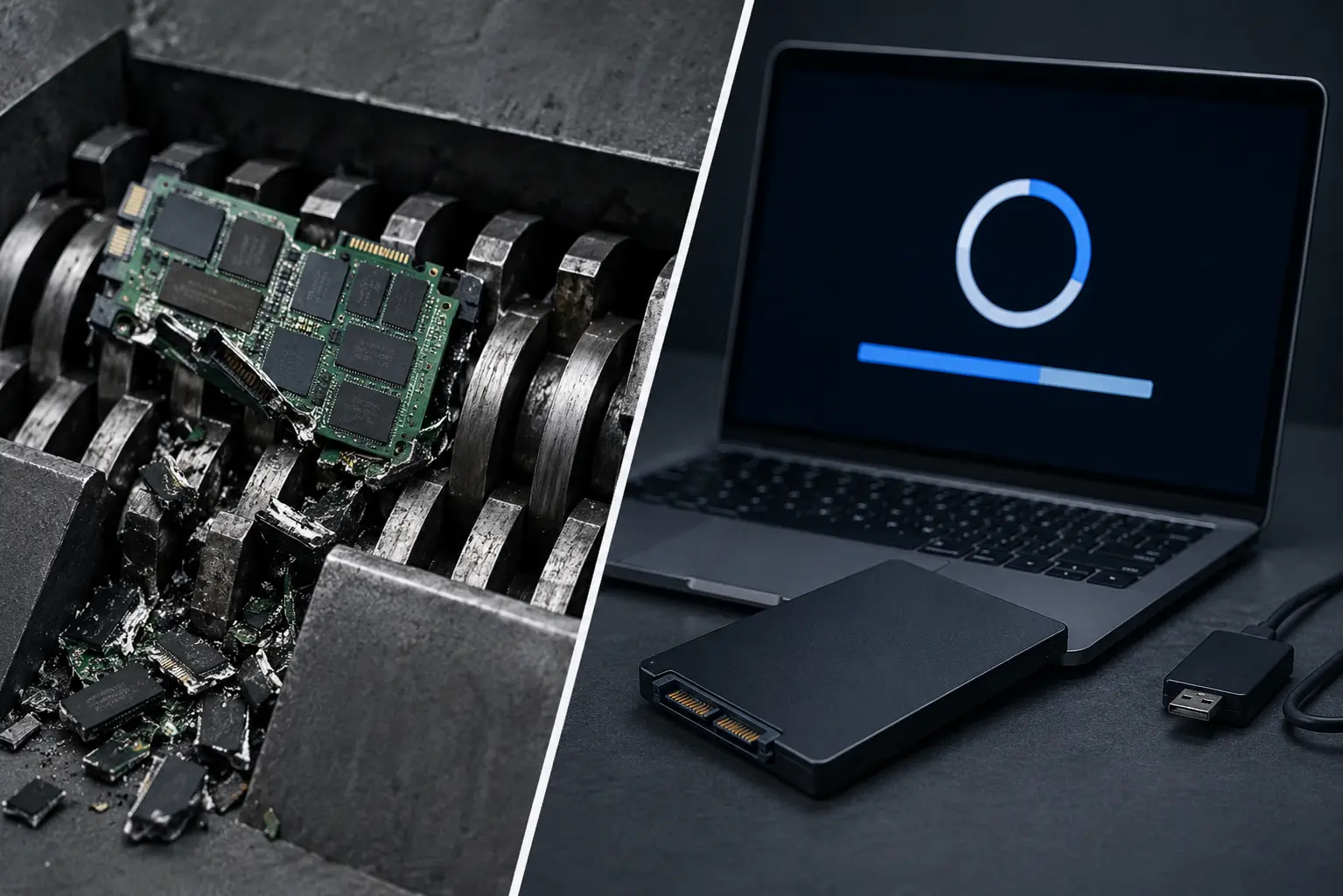
| Certified Software Wiping | Utilizes NCSC-approved cryptographic software to overwrite all data across every sector of the storage drive (both HDD and SSD). Preserves the physical integrity of the hardware. | Fully functional enterprise devices intended for financial remarketing, internal corporate redeployment, or charitable donation. |
| Hard Drive Shredding | The catastrophic mechanical destruction of the storage media into fragmented, unreadable particles. Advanced NCSC standards now legally require sub-2mm particle shredding for highly classified SSDs. | Mechanically failed drives, deeply obsolete technology, or highly classified defense, intelligence, and healthcare assets. |
| Electromagnetic Degaussing | Subjects traditional magnetic media to an immensely powerful electromagnetic field, permanently scrambling the magnetic domains and instantly destroying the data. | Legacy magnetic Hard Disk Drives (HDDs) and archival backup tapes. Crucial Note: Entirely ineffective on modern Solid State Drives (SSDs). |
| Granulation and Tape Destruction | Specialized industrial granulation and micro-shredding of magnetic backup tapes to ensure no historical data fragments can be physically reconstructed or read. | Large-scale archival IT clearances, historical data purges, and comprehensive data center decommissioning projects. |
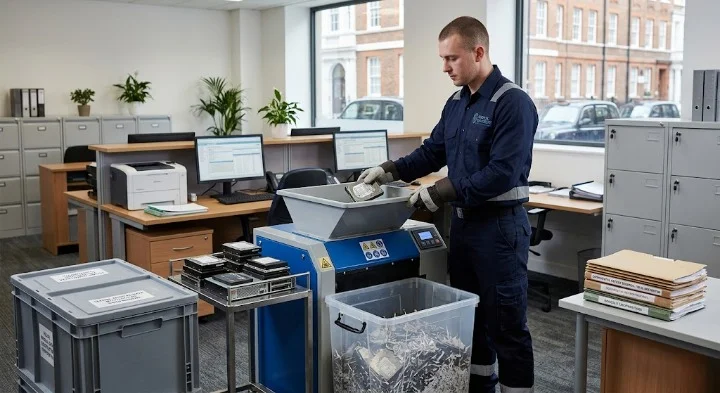
For corporate organizations possessing a zero-risk tolerance policy regarding data leaving their physical control, on-site data destruction has become an exceptionally highly sought-after service within the London market. Specialized mobile shredding vehicles and portable, military-grade degaussing units can be rapidly dispatched directly to corporate headquarters situated in high-density areas such as Canary Wharf or the Square Mile. This localized operational model allows corporate compliance officers, IT directors, and external auditors to physically witness and document the absolute destruction of hard drives and storage media before the resulting raw material fragments ever leave the corporate security perimeter, entirely eliminating transit risk.
Logistical Complexities of Operating ITAD Fleets in London
Executing highly secure IT asset collections within the Greater London area requires exceptionally specialized logistical capabilities. The capital presents a unique, highly challenging operational theater defined by intense traffic congestion, some of the strictest vehicular emissions regulations in the world, and highly complex building access protocols involving subterranean loading bays and strict security clearances.
Navigating the ULEZ and the Central Congestion Charge
In a major policy shift executed in August 2023, the Mayor of London significantly expanded the Ultra Low Emission Zone (ULEZ) to encompass all 32 London boroughs, stretching the regulatory boundary up to the edge of the M25 orbital motorway. Commercial and private vehicles that fail to meet exceptionally strict Euro 6 emissions standards face mandatory daily financial surcharges, while the central London Congestion Charge further penalizes any vehicular movement within the city’s innermost commercial core. For legacy ITAD providers still operating aging, heavily polluting diesel transport fleets, these compounding daily levies severely inflate the fundamental cost of collection logistics costs which are inevitably, and often quietly, passed down to the end client in the form of higher disposal fees.
Top-tier, modern ITAD partners have proactively adapted to this regulatory environment by investing heavily in fully ULEZ-compliant, advanced Euro 6, or entirely electric commercial vehicle fleets, allowing them to operate cost-effectively and sustainably across the entire capital. Furthermore, the enforcement of these zones has become highly aggressive. Transport for London (TfL) has significantly escalated enforcement actions against persistent ULEZ evaders, heavily utilizing debt recovery teams and bailiffs empowered to seize and auction non-compliant commercial vehicles. Engaging an ITAD provider with a non-compliant fleet introduces a bizarre but real risk: the potential for a vehicle carrying a client’s highly sensitive data to be legally intercepted or seized by enforcement agents due to unpaid civic fines.
Furthermore, to maintain an unbroken, legally defensible chain of custody, these compliant vehicles must be highly secure mobile fortresses. Enterprise-grade ITAD fleets feature real-time GPS telematics tracking, solid-sided non-windowed construction, advanced deadlocks, and continuous 360-degree CCTV monitoring. The use of unvetted third-party logistics couriers, standard parcel networks, or pallet networks is entirely unacceptable in modern ITAD, as it introduces severe, unmanageable vulnerabilities during the highly critical transit phase between the client’s office and the secure processing facility.
Servicing the 32 Boroughs and the Expansive M25 Corridor
The commercial demand for elite ITAD services extends far beyond the traditional central business districts of Westminster, Camden, and the City of London. Organizations spread across the entirety of Greater London from rapid-growth tech and media hubs in Shoreditch and Old Street to major, sprawling healthcare facilities in Croydon, and vast corporate administrative parks located along the M25 corridor in Surrey, Berkshire, and Essex require highly localized, hyper-responsive service.
A comprehensive, tier-one ITAD provider meticulously maps its logistical infrastructure to serve this vast, diverse catchment area with maximum efficiency. Whether the operation requires navigating severe loading bay height restrictions and unionized dockmasters in a high-rise Canary Wharf financial tower, or executing a highly complex, multi-site remote worker hardware retrieval program spanning hundreds of residential addresses across the Home Counties, the logistical operation must guarantee absolute security with zero disruption to the client’s daily commercial operations.
Environmental Economics and Corporate ESG Reporting
The global macroeconomic push toward a sustainable circular economy represents a fundamental, paradigm-altering shift in how international enterprises manage their hardware lifecycles. The UK is currently facing a massive environmental challenge, generating approximately 1.6 million tonnes of electronic waste annually, a figure that ranks the nation as one of the highest per capita producers of e-waste globally.
The Hidden Environmental and Carbon Costs of Hard Drive Shredding
While the physical, mechanical shredding of storage media is traditionally viewed as the ultimate, unquestionable guarantee of data destruction, it carries a remarkably heavy environmental toll that is frequently overlooked by compliance teams. The initial manufacturing and assembly of a single standard 1-Terabyte hard drive generates approximately 200 kilograms of carbon dioxide (CO2) equivalent. When a perfectly functional, healthy drive is mechanically shredded out of an overabundance of caution, the organization effectively destroys that embedded carbon value and forces the highly polluting global manufacturing cycle to repeat itself simply to replace that lost storage capacity. Furthermore, modern storage media contains highly critical rare earth elements such as cobalt and neodymium which are largely lost as unrecoverable, microscopic dust during the violent industrial granulation process, preventing their reuse in future technologies.
For modern organizations deeply committed to rigorous Environmental, Social, and Governance (ESG) targets and the aggressive reduction of Scope 3 supply chain emissions, certified software data erasure (wiping) is definitively the vastly superior sustainable choice. Secure cryptographic wiping preserves the physical integrity and functional utility of the hardware, allowing the device to be safely redeployed internally to other departments, donated to educational charities to bridge the digital divide, or sold on the global secondary market. Wiping substantially extends the asset lifecycle, defers carbon-intensive manufacturing processes, and directly supports the global macroeconomic transition away from a highly destructive, linear “take-make-dispose” economy toward a sustainable circular model.
Advanced ESG Metrics and Quantitative Impact Reporting
In 2026, leading IT directors and Chief Sustainability Officers expect their ITAD partners to provide far more than a basic waste transfer note; they demand enterprise-grade, highly granular environmental reporting. This goes substantially beyond a simple confirmation of recycling. Advanced, elite providers now deliver comprehensive Sustainability Impact Reports that quantitatively analyze the exact volume of greenhouse gas emissions avoided through refurbishment versus raw recycling, the precise metric weight of toxic materials successfully diverted from landfills, and the exact volume of base and precious raw materials recovered for reuse. As the stringent European Union Corporate Sustainability Reporting Directive (CSRD) and equivalent UK financial regulations dramatically expand their regulatory reach, these verifiable, scientifically backed metrics become absolutely essential for corporate compliance, stakeholder transparency, and annual public reporting.
Asset Value Recovery and IT Buyback Programs
For several decades, corporate organizations incorrectly viewed redundant IT equipment purely as a financial liability a sunk capital cost that required further operational expenditure simply to dispose of legally. In 2026, driven by shrinking hardware budgets and a deeper understanding of secondary markets, value recovery has become a core strategic priority for IT procurement teams. High-end enterprise hardware, including data center servers, advanced networking switches, premium enterprise laptops, and complete Apple hardware ecosystems, retains massive, highly liquid residual value on the global secondary market.
Sophisticated IT equipment buyback programs completely transform ITAD from a burdensome cost center into a highly lucrative revenue-generating operation. Elite providers like Computer Data Shred systematically evaluate surplus hardware fleets, securely and verifiably sanitize all data, professionally refurbish the physical components to Grade A or B standards, and then remarket the devices through an extensive network of global wholesale and direct retail channels.
Organizations typically choose between two primary, highly structured financial models when engaging in corporate value recovery :
| Value Recovery Financial Model | Operational Mechanism & Execution | Optimal Corporate Use Case |
| Instant Cash Buyback | The ITAD provider conducts an audit and offers a guaranteed, upfront financial lump sum based immediately on the current wholesale market value of the assets. The ITAD provider assumes 100% of all future resale and market fluctuation risk. | Organizations requiring rapid quarterly budget clearance, immediate cash flow injection, or those highly prioritizing absolute administrative simplicity and immediate closure. |
| Revenue / Profit Share Model | Assets are taken strictly on consignment. The provider refurbishes and actively sells the equipment into retail channels over time, taking a predefined percentage of the final sale price (typically a 50/50, 60/40, or 70/30 split favoring the client). | Organizations seeking to maximize absolute total financial return on high-value data center or late-model enterprise hardware, where immediate liquidity and time are less critical factors. |
By aggressively monetizing redundant technology assets, businesses can effectively offset the exorbitant costs of new technology procurement, independently fund complex data migration projects, or easily subsidize the relatively minor costs associated with specialized secure destruction services. In many instances, the residual value of the hardware completely eclipses the logistical and processing fees, resulting in a net-positive financial return for the client. Furthermore, intelligently integrating buyback models aligns perfectly with modern Corporate Social Responsibility (CSR) and Environmental, Social, and Governance (ESG) frameworks by maximizing hardware reuse.
Sector-Specific ITAD Requirements in the Capital
The sheer density of highly specialized, heavily regulated industries located within London necessitates highly tailored, bespoke ITAD operational frameworks. A generic, one-size-fits-all approach is wholly insufficient for the capital’s complex, multifaceted economy.
Healthcare and the NHS Ecosystem
London proudly hosts several of the UK’s largest, most complex healthcare providers, including Barts Health, King’s College Hospital, and Imperial College Healthcare. These massive organizations manage immense volumes of highly sensitive, deeply personal patient data that is rigidly governed by the NHS Information Governance (IG) Toolkit, the Caldicott Guardian principles, and the Data Protection Act. For these institutions, ITAD frequently requires rigid on-site physical destruction capabilities to guarantee that no patient records ever physically leave the hospital premises intact. Furthermore, any procurement of ITAD services must demonstrate strict, pre-vetted adherence to Crown Commercial Service (CCS) public procurement frameworks.
Financial Services and the Corporate Enterprise
The globally significant financial institutions securely headquartered in Canary Wharf, the Square Mile, and Mayfair operate under the intense, constant scrutiny of the Financial Conduct Authority (FCA) and the Prudential Regulation Authority (PRA). Their unique ITAD requirements often involve highly complex, large-scale data center decommissioning, requiring the meticulously synchronized shutdown, cryptographic wiping, and physical removal of massive server racks and multi-petabyte Storage Area Networks (SANs). These delicate operations demand out-of-hours service execution to completely minimize network disruption, multi-layered advanced vendor personnel vetting (including BS7858 background checks), and absolute zero-subcontracting guarantees to definitively eliminate any theoretical risk of third-party data interception or espionage.
Integrated Office Clearance and Computer Data Shred Solutions
A major, highly disruptive operational challenge for businesses undergoing corporate relocation, strategic downsizing, or sweeping infrastructure refresh programs is managing the sheer variety and volume of assets seamlessly. Coordinating multiple, disparate vendors for basic furniture removal, specialized IT disposal, and general facilities waste is highly inefficient, deeply costly, and drastically increases the risk of dangerous chain-of-custody security failures.
Providers such as Computer Data Shred resolve this administrative friction entirely by providing a highly consolidated, master-managed Full Office Clearance & Recycling solution. Rather than treating ITAD as an isolated, standalone event, their expert, multi-disciplinary teams systematically manage the simultaneous, secure extraction of heavy office furniture, architectural fixtures, general consumables, and highly sensitive IT equipment (including rack servers, edge networking gear, and individual workstations) within a single operational window.
This seamlessly integrated approach offers distinct, highly measurable benefits for busy London clients:
- Embedded Security Protocols: The physical extraction of data-bearing IT assets is coupled directly and immediately with NCSC-standard certified data sanitization. Devices are securely wiped via software or physically shredded, generating immediate, audit-ready compliance documentation before the hardware leaves the client’s control.
- Advanced Lease Return Management: Computer Data Shred provides comprehensive IT Asset Management (ITAM) reporting utilizing advanced software tracking. This tracks equipment precisely during removal, ensuring that leased hardware is accurately identified, cryptographically wiped, and returned to financial lessors according to strict contractual tolerances, thereby allowing the client to avoid exorbitant financial penalties for lost or damaged leased assets.
- Maximized Waste Diversion: Explicitly designed to support ambitious corporate social responsibility (CSR) goals, this methodology routinely, verifiably diverts up to 95% of total office waste away from landfills. Usable furniture and functional IT assets are funneled toward trusted, audited charity partners, while surplus premium technology is prepped for wholesale resale.
Evaluating and Selecting a Certified ITAD Partner
With over 800 registered IT disposal entities currently operating across the UK, identifying a provider genuinely capable of delivering highly secure, fully compliant, and environmentally responsible service is a deeply daunting task for procurement professionals. Critical industry analysis suggests a stark reality: less than 10% of these registered providers operate at a standard that genuinely satisfies modern enterprise-grade risk mitigation and compliance requirements.
To evaluate an ITAD provider effectively, organizations must look entirely beyond polished marketing claims and aggressively demand verifiable, independent proof of systemic governance. True certification in 2026 is not a single, static achievement but rather a complex matrix of independently audited operational frameworks.
Mandatory Certifications and Frameworks for 2026 Procurement:
- ISO 27001 (Information Security Management): This is the absolute, non-negotiable baseline for any provider. It proves the vendor operates a continuously audited Information Security Management System (ISMS), ensuring that client data is protected through rigorous physical access controls, comprehensive staff vetting, and tested incident response protocols.
- ISO 14001 (Environmental Management): Guarantees the provider adheres strictly to all environmental legislation, actively preventing illegal e-waste dumping and ensuring all downstream recycling partners are similarly audited and legally compliant.
- ISO 9001 (Quality Management): Ensures highly consistent, repeatable service delivery models and a documented commitment to continuous operational improvement.
- Cyber Essentials Plus: A highly regarded UK government-backed scheme demonstrating that the ITAD provider’s own internal corporate IT infrastructure is fully resilient against common cyber threats, thereby safeguarding the client’s highly sensitive asset registers and Certificates of Destruction from being hacked while stored on the vendor’s servers.
- Environment Agency Registration: The processing facility must legally operate as an Approved Authorised Treatment Facility (AATF) or hold the appropriate, specific T11 waste exemptions and high-tier Waste Carrier Licenses.
Furthermore, exceptional, tier-one providers offer an absolute, legally binding zero-subcontracting guarantee for secure logistics. Relying on external, standard logistics networks completely breaks the fundamental chain of custody. True, unassailable security dictates that from the exact moment an asset is physically unplugged in a London office to the moment it is cryptographically destroyed or physically wiped, it remains entirely, exclusively under the strict custody of the certified ITAD provider’s own vetted personnel.
Advanced Software Tracking and the Role of AI in ITAD
The scale at which ITAD operates in the modern era requires highly sophisticated software backends. Gone are the days of manual spreadsheets and rudimentary inventory lists, which are highly prone to catastrophic human error, duplicate entries, and missing data. Modern ITAD relies on complex, cloud-based software solutions (similar in scope to systems like CycleLution or Evercycle) that provide full-lifecycle asset tracking.
These platforms allow providers to track thousands of assets simultaneously for instance, seamlessly managing the recovery of over 9,000 devices from thousands of remote locations in highly compressed timeframes. They facilitate API integration directly into a client’s existing IT Service Management (ITSM) tools (such as ServiceNow), ensuring that when an asset is marked as disposed of by the ITAD provider, the client’s internal system is automatically updated with the Certificate of Destruction.
Looking toward the immediate future, Artificial Intelligence (AI) is rapidly penetrating the ITAD sector. In 2026, advanced platforms are beginning to utilize AI for highly predictive refresh modeling analyzing vast datasets of hardware performance to forecast the exact, optimal moment for asset disposition, thereby maximizing secondary market resale value while simultaneously minimizing the risk of hardware failure in the field. AI is also deployed to assist in automated cosmetic and functional grading, and for chain-of-custody anomaly detection, significantly reducing the margin for human error and accelerating processing times. Additionally, AI-driven ESG optimization engines now help providers model the exact environmental impacts of choosing to reuse versus recycle a specific batch of assets.
Frequently Asked Questions (FAQ) Regarding IT Asset Disposal in London
What is the precise difference between general IT recycling and IT Asset Disposition (ITAD)?
While the terms are frequently, though incorrectly, used interchangeably by laypersons, IT recycling generally refers strictly to the physical breakdown of end-of-life electronic waste to recover raw materials (plastics, base metals) for purely environmental purposes. Conversely, IT Asset Disposition (ITAD) is a vastly more comprehensive, deeply security-focused discipline. It encompasses the highly secure logistical retrieval of assets, guaranteed cryptographic data destruction to military standards, rigorous legal compliance reporting, and the active financial recovery of asset value through professional refurbishment and global resale, with raw material recycling acting strictly as an absolute last resort when an asset holds zero utility.
Does our business still require a formal Certificate of Destruction if we choose to wipe the hard drives internally using our own IT staff?
Absolutely. Internal wiping protocols frequently rely on substandard, free software that leaves substantial residual data fully accessible to commercial forensic recovery tools. Furthermore, internal self-certification entirely lacks legal impartiality. In the event of a severe data breach or a targeted audit by the Information Commissioner’s Office (ICO), organizations must be capable of producing an independent, serialized Certificate of Destruction generated by an accredited, external third-party processor (such as an ISO 27001 certified provider) to definitively prove adherence to GDPR Article 28 processor requirements.
How do you practically handle data destruction for remote hybrid employees located in London and the surrounding Home Counties?
To effectively secure the highly vulnerable remote operational edge, advanced providers utilize specialized, highly refined remote ITAD logistics frameworks. This process involves dispatching highly secure, individually trackable, and visibly tamper-evident packaging directly to the employee’s residential location. The asset is continuously tracked via GPS telematics during transit back to the secure processing facility. Upon arrival, it undergoes certified data wiping or physical shredding, ensuring the chain of custody remains absolutely intact and legally defensible without ever requiring the employee to travel physically to a central corporate office to surrender the hardware.
Are “free IT recycling” services advertised in London actually legitimate?
Legitimate free IT recycling services do indeed exist, provided they are structured around a clear, logical financial model. Professional providers can realistically offer free collection and processing if the business is retiring a sufficient quantity of high-value hardware (typically a minimum of 10 or more functional, relatively modern devices). The provider essentially offsets the substantial logistical overhead and data-wiping costs by recovering value through the refurbishment and subsequent resale of the functional equipment. However, organizations must exercise extreme, heightened caution with opaque entities offering free recycling without a clearly defined value recovery model, as these are frequently unregulated scrap merchants who may illegally fly-tip the waste or, worse, sell the data-bearing drives entirely intact on the black market.
What exactly happens to our IT equipment during a comprehensive full office clearance?
When engaging a sophisticated provider like Computer Data Shred for a full, integrated office clearance, IT assets are meticulously decoupled from general office waste streams at the source. Dedicated, vetted security teams carefully extract the data-bearing devices (such as servers, laptops, and media tapes) and subject them to immediate, segregated data sanitization protocols. The provider rigorously logs individual serial numbers to generate comprehensive IT Asset Management reports, ensuring all leased equipment is perfectly accounted for and all compliance documents are issued before the assets are safely diverted to either revenue-generating resale channels or WEEE-compliant raw recycling.
How does the London ULEZ expansion explicitly impact the logistics of ITAD collections?
The aggressive expansion of the Ultra Low Emission Zone means that any commercial transport vehicle entering Greater London that fails to meet exceptionally strict Euro 6 emissions standards is subject to heavy daily financial surcharges. Non-compliant ITAD providers operating legacy fleets frequently pass these excessive, unnecessary logistics costs directly onto the client via hidden fees. Therefore, it is financially and operationally imperative to partner exclusively with established, forward-thinking providers operating modern, fully ULEZ-compliant, or entirely electric vehicle fleets to ensure highly cost-effective and genuinely environmentally sound asset retrieval.
Conclusion
The secure disposition of IT assets within the complex ecosystem of London requires a highly sophisticated, multi-disciplinary approach that perfectly balances uncompromising data security, rigid adherence to environmental compliance, and the intelligent optimization of financial returns. As regulatory enforcement bodies such as the ICO and the NCSC continue to elevate their technical standards and aggressiveness, and as corporate ESG commitments rapidly transition from voluntary marketing guidelines into strictly mandatory reporting metrics under directives like the CSRD, the era of treating end-of-life hardware as mere electronic waste is definitively, permanently over.
For commercial enterprises, financial institutions, and public bodies operating in the capital, partnering with a fully certified, rigorously auditable ITAD specialist is no longer an optional luxury it is an absolute, foundational requirement for basic corporate risk management. Elite providers that successfully leverage deeply integrated services spanning localized, emissions-compliant secure logistics, forensic-grade data destruction methodologies, comprehensive WEEE recycling protocols, and highly lucrative asset buyback programs empower modern businesses to definitively close their technology lifecycles securely, profitably, and sustainably. By consistently demanding absolute operational transparency, independent third-party certification, and unbroken chain-of-custody protocols from their vendors, London enterprises can successfully protect their sensitive data, safeguard their hard-earned corporate reputations, and actively, measurably contribute to the global circular economy.